-110x110.png)
IVD检测试纸询价需要确认什么
先核对用途、规格与目标市场要求,再比较价格、包装和交付条件。
核心规格
- 检测项目、方法学和样本类型
- 专业使用或自测用途及目标人群
- 定性或定量、检测范围与判读方式
- 配套仪器、校准、质控品和软件版本
- 有效期、储存温度、开封稳定性与运输条件
采购输入
- 目标国家、渠道及进口主体
- 所需注册路径和证书类型
- 预计年用量、批量和供货节奏
- 标签语言、说明书、UDI或追溯要求
- 冷链或常温运输、目的港与清关资料
IVD页面不承诺任何具体产品已获准进入某一市场。只有取得并核验真实、有效且覆盖拟采购型号的文件后,才进入正式报价与供应流程。
IVD检测试纸质量与合规核验
IVD产品不能仅凭“有CE”或“有FDA”判断可销售。应核对法规体系、证书类型、产品用途、型号、制造商、公告机构或数据库状态。
监管路径
美国项目核对具体510(k)或其他适用途径;欧盟项目核对IVDR下的证书与过渡安排。
产品对应
确认检测项目、样本、用途、仪器和试纸型号均在文件范围内。
性能与质控
审查灵敏度、特异性、重复性、干扰、稳定性与质控方案。
储运与追溯
核对效期、温度记录、批号、放行文件、召回和投诉处理机制。
典型采购场景
不同销售渠道应分别规划规格、包装、库存与补货方式。
专业检测渠道
重视实验室流程、仪器兼容、质控与专业人员使用说明。
零售或自测渠道
重视自测用途是否获批、用户研究、语言和消费者说明。
经销商批量采购
重视注册范围、效期结构、批次文件和持续供应。
IVD检测试纸采购常见问题
有510(k)编号就可以采购吗?
仍需核对编号状态、持有人、制造商、产品名称、用途和拟采购型号是否一致。
IVDD证书可以直接当作IVDR证书吗?
不能简单等同,应结合产品分类、证书状态和适用过渡规则进行核验。
可以先发样品再核验证书吗?
研究性样品和商业销售要求不同。正式采购或市场投放前必须完成目标市场合规核验。
获取IVD检测试纸采购建议
请提供用途、规格、数量、目标国家、认证要求和计划交期。
IVD检测试纸出口采购核验清单 IVD Test Strips
以下内容用于建立可比较、可追溯的采购条件,不代表任何具体型号已经取得目标市场许可。
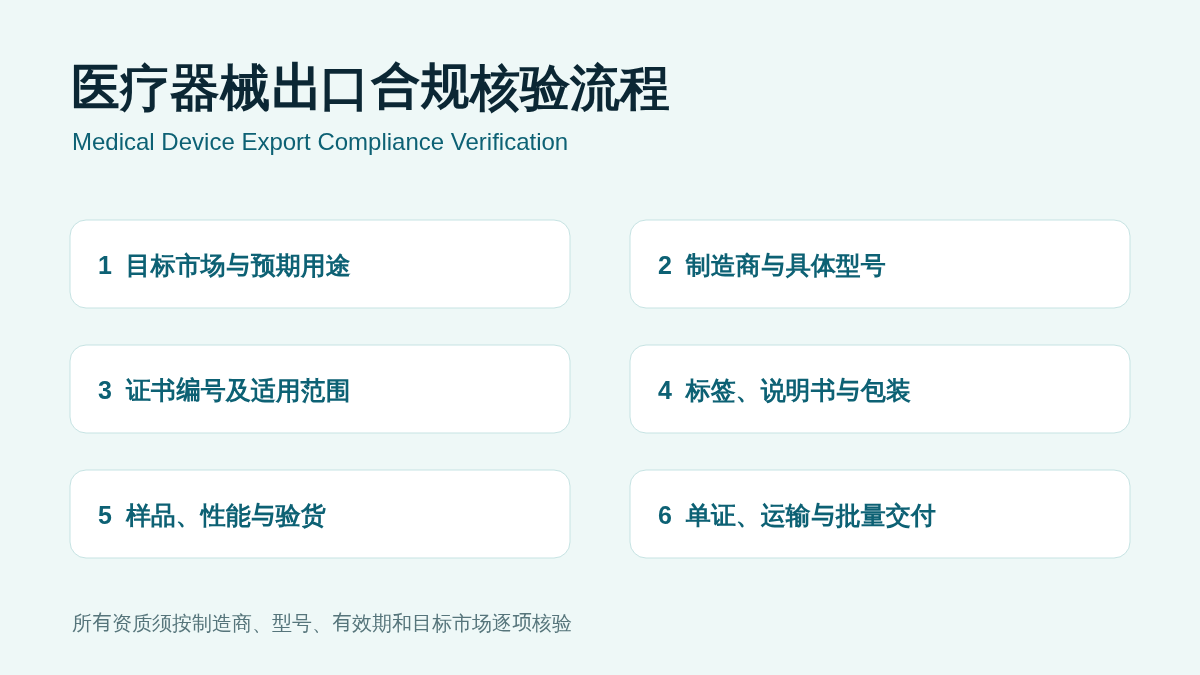
International buyer verification checklist
1. IVD Test Strips: intended use and target market
Before quotation, define the intended use, user group, operating environment, destination country, import route, sales channel and local-language obligations for the IVD test strip system. These facts can affect classification, evidence, labeling and registration. A catalogue or supplier statement is not proof of market access. Verify the exact legal manufacturer, manufacturing site, brand, model, configuration and destination-market scope. Record assumptions in writing, because a change in use, user, accessory or sales country can require a new assessment even when the product appears similar.
2. IVD Test Strips: specification baseline
Create a controlled data sheet covering analyte, intended use, qualitative or quantitative result, specimen type, compatible instrument, measuring range, cut-off, interference, lot calibration, storage and shelf life. Ask every candidate supplier to respond to the same fields and identify optional items separately. Undefined terms should be resolved before samples or quotations are compared. Final specifications must be supported by manufacturer documents, approved samples and purchase-contract requirements; this page does not confirm the specification or availability of any model.
3. IVD Test Strips: Review performance evidence
Request current performance summaries and test reports that match the proposed model. The review should cover accuracy, precision, repeatability, interference, usability, stability, transport conditions, and lot consistency where applicable. Acceptance criteria must be agreed before sampling or inspection. Buyers should not rely only on marketing statements such as high accuracy or fast testing. Any performance claim used on packaging, websites, catalogues, or distributor materials should be supported by evidence controlled by the manufacturer and permitted in the destination market.
4. IVD Test Strips: Verify regulatory documents
For the United States, ask for the relevant establishment, device listing, premarket submission, or exemption basis as applicable, and independently verify the exact product information through official sources. For the European market, confirm the applicable regulatory route, declaration of conformity, notified body involvement when required, certificate scope, authorized representative, UDI responsibilities, and language obligations. FDA, CE, 510(k), and other references must never be copied from a different factory, brand, family, or model. Start with the official FDA medical devices resource and obtain professional regulatory advice for the destination market.
5. IVD Test Strips: Check labeling and packaging
Approve the product label, retail box, master carton, instructions, symbols, warnings, importer information, traceability elements, barcodes, manufacturing date, expiry date, storage conditions, and country-specific language before mass production. Private-label projects require written allocation of responsibilities for artwork approval and change control. Confirm whether the quotation includes printing plates, color boxes, manuals, control solution, lancets, batteries, and export cartons. Packaging validation should reflect the shipment method and distribution environment rather than only the appearance of the retail package.
6. IVD Test Strips: samples, production and inspection
Use an approved reference sample and signed specification sheet for the IVD test strip system. The purchase contract should identify the manufacturer, model or reference, included items, packaging revision, quantity tolerance, inspection standard and required documents. During production, control critical materials and any proposed substitution. Pre-shipment inspection can cover kit identity, strip lot, instrument compatibility, controls, labeling, instructions, packaging integrity, storage evidence and performance documentation. Inspection helps detect differences from the approved sample but does not replace regulatory approval, qualified laboratory work or destination-market review.
7. IVD Test Strips: logistics and after-sales support
Confirm unopened and opened stability, temperature, humidity, light protection, cold-chain needs and remaining shelf life. Record carton dimensions, gross weight, pallet plan, shipping marks, handling instructions and any battery or dangerous-goods considerations. For recurring orders, plan safety stock for test strips, reagents, controls, calibrators, collection items, compatible instruments, manuals and temperature-controlled packaging. Agree how damage, shortage, complaints, replacement parts, corrective action and possible recalls will be handled. Distribution and warehouse controls should preserve identification, traceability and approved storage conditions through final delivery.
8. IVD Test Strips: supplier identity and responsibility
Identify the legal manufacturer, production address, specification owner, brand owner, exporter and any authorized representative for the IVD test strip system. The invoicing company may differ from the manufacturer shown on regulatory documents. In OEM or private-label projects, document who controls design, risk management, performance evidence, labeling, change control, vigilance and post-market responsibilities. Changes to the factory, brand, material, component, software or model scope require documented review rather than an assumption that earlier evidence still applies.
9. IVD Test Strips: options and configuration control
List every selectable configuration, accessory, consumable, language, package and private-label option for the IVD test strip system. Identify which combinations are covered by the quoted documents and which require separate evaluation. If software, connectivity, batteries or powered accessories apply, confirm versions, interfaces, update responsibilities and compatibility. The supplier should control configuration changes and notify the buyer before substitution. A commercial option must not be represented as approved for the destination market until its exact scope has been verified.
10. IVD Test Strips: sample evaluation protocol
Prepare a written sample protocol for the IVD test strip system. Record manufacturer, model, lot or serial information, configuration, accessories, document revision, packaging version and receipt date. Evaluate kit identity, strip lot, instrument compatibility, controls, labeling, instructions, packaging integrity, storage evidence and performance documentation. Where performance or laboratory evaluation is required, use a competent organization and documented method. Retain approved samples and evidence as production references. Sample acceptance applies only to the evaluated configuration and does not automatically approve future changes or substitutions.
11. IVD Test Strips: quotation comparison
Require every supplier to quote the same specification and separate the costs of test strips, reagents, controls, calibrators, collection items, compatible instruments, manuals and temperature-controlled packaging. Record minimum order quantity, lead time, payment terms, warranty, replacement policy, production capacity, sample cost, inspection, tooling, artwork, documents and freight terms. Compare total landed and lifecycle cost rather than only the unit price. Exclusions, optional items and assumptions should be written clearly so that commercial comparison does not conceal a missing accessory, short shelf life, unsuitable package or unsupported claim.
12. IVD Test Strips: traceability and change control
Define traceability for the IVD test strip system from finished lot or serial number to production and supplied materials. Purchase documents should require advance notice of material, component, software, packaging, manufacturing-site and regulatory changes. Decide which changes require new documents, samples, tests, artwork or commercial approval. Maintain a controlled file of quotations, specifications, samples, certificates, declarations, reports, labels, inspection results, shipping records, complaints and change notices. Revision dates should show which evidence applied to each shipment.
13. IVD Test Strips: complaint and recall readiness
Agree a route for complaints, technical investigation, replacement decisions, reporting, corrective action and recall involving the IVD test strip system. Required records may include model, lot or serial identifiers, photographs, storage history, user description, accessories and returned samples. Responsibilities and timelines depend on the destination market and contractual roles. Sales staff should not make unsupported medical conclusions. The legal manufacturer or qualified regulatory party should assess reportability, corrective action and any field safety obligations.
14. IVD Test Strips: shipment release file
Before shipment, check the approved order, specification, quantity, production identification, expiry or service-life information where applicable, carton marks, inspection report, invoice, packing list, origin documents and destination-specific evidence for the IVD test strip system. Compare manufacturer and model information across labels, instructions, declarations, certificates and shipping records. Resolve inconsistencies before release. For consolidation or overseas warehousing, define storage, stock rotation, damage handling and traceability. Release should follow a completed checklist rather than an informal message.
15. IVD Test Strips: information required for an accurate inquiry
A useful inquiry for the IVD test strip system states destination country, intended user, distribution channel, estimated quantity, target delivery, required configuration, language, packaging, accessories, private-label needs and documents to be reviewed. Also state whether samples, third-party testing, factory audit, pre-shipment inspection, palletization or overseas warehouse support are required. When these conditions are unknown, any response is preliminary. Final selection, pricing, lead time and suitability require confirmation with the manufacturer and buyer before a binding order.
16. IVD Test Strips: factory capability review
Review whether the proposed manufacturing site controls incoming materials, production, environmental conditions where relevant, in-process checks, release testing, nonconforming output and record retention for the IVD test strip system. A company presentation is not evidence that the quoted model is made at the stated site. Identify critical subcontractors and quality agreements. Compare capacity claims with equipment, validated processes, staffing, material supply and realistic lead times. Factory review should match the exact product and service scope being purchased.
17. IVD Test Strips: quality agreement
A quality agreement can define document ownership, acceptance criteria, lot release, retention samples, complaint cooperation, change notification, audit rights, confidentiality, and record availability. It should be consistent with the commercial contract and regulatory roles. The buyer should identify which documents are required with every shipment and which may be reviewed periodically. Where translations are used, establish the controlling language and an approval route. Do not treat a certificate as a complete quality agreement. Certificates describe a limited scope and period, while the agreement controls day-to-day responsibilities for the specific products and transactions.
18. IVD Test Strips: shelf life, service life and stability
Confirm unopened and opened stability, temperature, humidity, light protection, cold-chain needs and remaining shelf life. Ask how claimed periods and limits were established, which conditions apply after opening or assembly, and what remaining validity will be delivered. Evaluate expected transport and warehouse conditions, including temperature, humidity, light, vibration and stacking as applicable. An external carton alone does not prove protection through sea, air, road or warehouse handling. Excursions, damage and expired evidence require documented assessment rather than automatic acceptance.
19. IVD Test Strips: localization control
Localization of the IVD test strip system can include labels, instructions, warnings, symbols, units, date formats, customer-service details, packaging claims, quick guides, software or screen text where applicable. Use qualified technical review and maintain approved artwork with revision history. Compare production samples against the controlled files. Machine translation without review can create misleading or unsafe information. Agree who owns translation accuracy, regulatory review, printing approval and removal of obsolete material after changes.
20. IVD Test Strips: tender and distributor documentation
Institutional tenders and distributor onboarding often require a structured document package. Prepare a list before quotation that may include company registration, manufacturing information, quality certificates, product declarations, applicable market authorizations, technical specifications, test summaries, labeling, instructions, warranty terms, after-sales procedure, and references permitted by law. Each document should show its issuer, model scope, revision, date, and validity where relevant. Avoid mixing documents from different configurations. If a tender requirement cannot be met, record the gap clearly rather than substituting an unrelated certificate or changing the wording of the requirement.
21. IVD Test Strips: inspection sampling and acceptance
Set inspection scope for the IVD test strip system according to risk, order size, supplier history and agreed specifications. Define lot formation, sample size, acceptance criteria and treatment of critical, major and minor defects. Checks may include kit identity, strip lot, instrument compatibility, controls, labeling, instructions, packaging integrity, storage evidence and performance documentation. Any destructive, clinical or laboratory assessment requires suitable methods and competence. The report should identify the lot, sample, method, findings, photographs and disposition and must not be presented as a regulatory certificate.
22. IVD Test Strips: payment and commercial risk
Commercial terms should protect both parties without weakening quality controls. Align deposits, production milestones, balance payment, inspection, document approval, and shipment release. Clarify the Incoterm, nominated carrier, insurance, bank charges, customs responsibility, and consequences of delay or failed inspection. If a supplier requests payment to a different company, verify the relationship and contractual authority. Avoid approving production before specifications and artwork are frozen. A clear change-order process helps prevent disputes when quantity, packaging, accessories, language, or delivery plans change after quotation.
23. IVD Test Strips: ongoing supplier monitoring
Supplier approval for the IVD test strip system is not permanent. Monitor delivery, document expiry, inspection results, complaint trends, corrective action, change notices, responsiveness and lot consistency. Establish review intervals based on risk and purchase volume. New sites, materials, components, software, accessories, packaging or market authorizations can trigger reassessment. Objective records and measurable expectations support stable supply and earlier detection of problems; repeated exceptions without investigation increase commercial and regulatory risk.
24. IVD Test Strips: boundaries of this sourcing service
The sourcing process can coordinate supplier identification, document collection, quotation comparison, sampling, inspection, packaging, logistics, and communication. It does not replace the legal manufacturer, accredited laboratory, notified body, regulator, importer, authorized representative, or professional legal advice. Final classification and market-access decisions must be made for the exact product and destination. No wording on this page should be interpreted as confirmation that a particular model is approved, registered, cleared, certified, or suitable for a specific clinical purpose until the supporting evidence has been reviewed and accepted.
25. IVD Test Strips: final decision record
Before placing the order, create a decision record that summarizes the intended market, selected manufacturer and model, supporting documents, approved samples, open risks, responsible parties, inspection plan, delivery terms, and final approvals. Link each conclusion to a dated source document. Record unresolved assumptions and the person authorized to accept them. This final review helps prevent a commercial quotation from being mistaken for technical or regulatory approval. It also provides a useful baseline for repeat orders, supplier changes, customer questions, and post-market investigations.
26. IVD Test Strips: controlled document index
Create a document index that lists every file received for the proposed product, including issuer, document number, revision, date, expiry where applicable, covered manufacturer, covered site, model scope, language and verification status. Link conclusions to the exact file rather than a screenshot or sales message. Mark superseded documents clearly and restrict uncontrolled copies. The index should identify missing information, responsible reviewers and the date of the next review. A complete index reduces delays during customer qualification, customs questions, tender preparation, repeat orders and post-market investigation while preventing unrelated evidence from being attached to the wrong product.
27. IVD Test Strips: sample-to-order consistency
Compare quotation, approved sample, specification, artwork, production order, inspection record and shipping documents before release. Names, references, accessories, materials, claims and package quantities should remain consistent. If a difference is accepted, record who approved it, why it was acceptable and whether new technical or regulatory review was required. Do not allow a production convenience to become an undocumented specification change. For repeat orders, compare the new lot with the controlled baseline and previous corrective actions. This discipline supports predictable quality and gives both buyer and supplier a clear record when questions arise.
28. IVD Test Strips: claims and marketing governance
Review every performance, clinical, safety, durability and compatibility claim before it appears in catalogues, online listings, packaging, manuals or distributor materials. The wording should match available evidence and destination-market rules. Avoid absolute claims, unsupported comparisons and statements copied from another manufacturer or model. Translations should preserve the approved meaning. Keep a claims matrix that identifies the statement, supporting evidence, approved markets, media where it may be used and responsible reviewer. Commercial teams should use only controlled material and request review before creating new claims for campaigns, tenders or customer presentations.
29. IVD Test Strips: warehouse and stock governance
Document receiving inspection, location control, storage conditions, lot or serial traceability, first-expiry-first-out rules where applicable, damaged-stock segregation, cycle counting, picking verification and dispatch records. Warehouse staff should be able to identify product status and prevent obsolete, recalled, expired or unapproved stock from shipping. When overseas inventory is planned, define replenishment triggers, safety stock, replacement parts and responsibility for local returns. Audit records should connect each outbound shipment with its source lot and approved documentation. Warehouse capability must be verified rather than assumed from a general statement that overseas stock is available.
30. IVD Test Strips: final inquiry checklist
Send the destination country, intended use, buyer type, annual forecast, first-order quantity, required delivery date, preferred configuration, packaging language, private-label request, inspection needs, warehouse plan and document checklist in one structured inquiry. Ask the supplier to identify exceptions and assumptions instead of answering only with a price. The resulting quotation should be version controlled and linked to the offered manufacturer and model. Before confirmation, close every critical gap or record an authorized risk decision. This approach produces a clearer comparison, a more reliable contract and a faster route from sample evaluation to compliant commercial delivery.